
Gas Prices Just Jumped 30% — Here's What That Actually Costs You Per Week (and What to Do About It)
Gas prices have surged 35% in a single month — climbing from $2.95 to $3.98 per gallon between February 27 and March 27, 2026, according to AAA's Fuel Gauge Report. That's not just a number on a gas station sign. It's money leaving your bank account every single week.
Here's exactly how much this increase costs different households, why it hits some families 2.5× harder than others, and four specific strategies that can save you up to $1,334 per year.
TL;DR
- Gas prices jumped $1.03/gallon (35%) in one month — the average household now pays an extra $40/month ($487/year)
- The increase hits low-income households 2.5× harder as a share of income — functioning as a stealth regressive tax
- Prices are above $3 in all 50 states for the first time since 2023
- Recovery will take 1–3 months minimum, even if oil prices stabilize today
- Four strategies can offset the increase: price shopping, trip consolidation, commuter benefits, and pay-per-mile insurance — saving up to $1,334/year combined
Table of Contents
- The Numbers: How Much Gas Prices Actually Jumped
- What a $1.03 Increase Actually Costs You
- The Stealth Regressive Tax: Who Gets Hit Hardest
- When Will Gas Prices Drop?
- 4 Ways to Cut Your Gas Spending Now
- Frequently Asked Questions
The Numbers: How Much Gas Prices Actually Jumped
The national average gas price hit $3.98 per gallon on March 27, 2026 — up from $2.95 just one month earlier. That's a $1.03 increase, or roughly 35%, according to AAA's Fuel Gauge Report.
For the first time since 2023, gas is above $3 per gallon in all 50 states, according to Business Insider. Brent crude oil has surged to approximately $100 per barrel — a 38% increase from its pre-conflict price of $73, as reported by FactSet via CBS News.
The impact is already showing up in consumer spending. Bank of America Institute data shows a 14.4% year-over-year increase in gasoline spending on credit and debit cards for the week ending March 14. The University of Michigan's Consumer Sentiment Index dropped to 53.3 in March — a three-month low — with year-ahead inflation expectations jumping to 3.8%.
This isn't a minor fluctuation. The OECD has revised its U.S. 2026 inflation forecast to 4.2%, up from 2.8% in December — a 1.4 percentage point revision, according to Forbes.
What a $1.03 Increase Actually Costs You
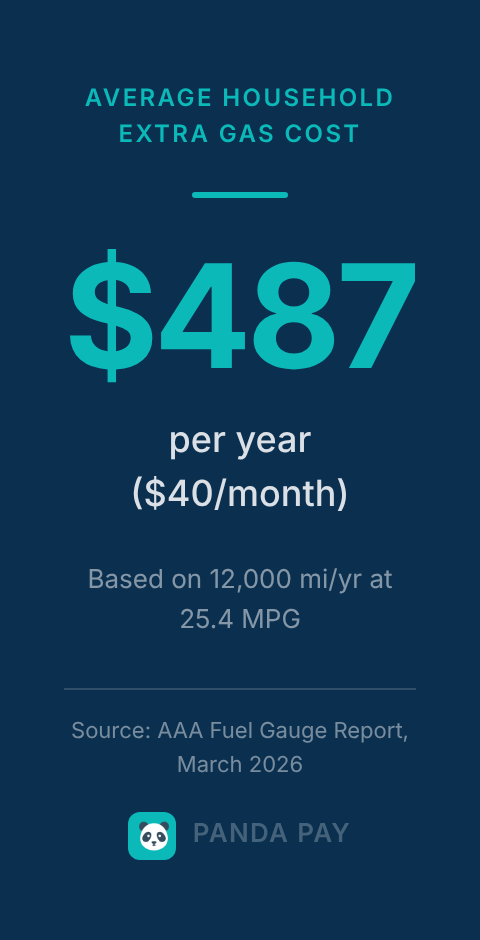
The average American household drives 12,000 miles per year at 25.4 MPG (EPA average). That works out to about 472 gallons annually. Multiply by the $1.03/gallon increase and you get $487 per year — or about $40 per month in extra gas costs alone.
But "average" hides a wide range. Here's what the increase actually costs depending on your driving profile:
| Household Type | Miles/Year | Extra Per Week | Extra Per Month | Extra Per Year |
|---|---|---|---|---|
| Single commuter | 10,000 | $7.80 | $33.79 | $406 |
| Average household | 12,000 | $9.36 | $40.55 | $487 |
| Suburban family | 15,000 | $11.70 | $50.69 | $608 |
| Rural/long commute | 20,000 | $15.60 | $67.59 | $811 |
| Two-car household | 24,000 | $18.72 | $81.10 | $973 |
Based on 25.4 MPG average and $1.03/gallon increase. Source: AAA, EPA
To put $40/month in perspective: that's roughly a Netflix and Hulu subscription combined. Or four lunches out. Or half an electric bill. Most people feel the squeeze without ever doing the math — which is exactly what makes gas prices so effective at quietly draining household budgets.
The Stealth Regressive Tax: Who Gets Hit Hardest
The $487/year increase costs the same in dollars for everyone. But it doesn't hurt everyone equally — not even close.
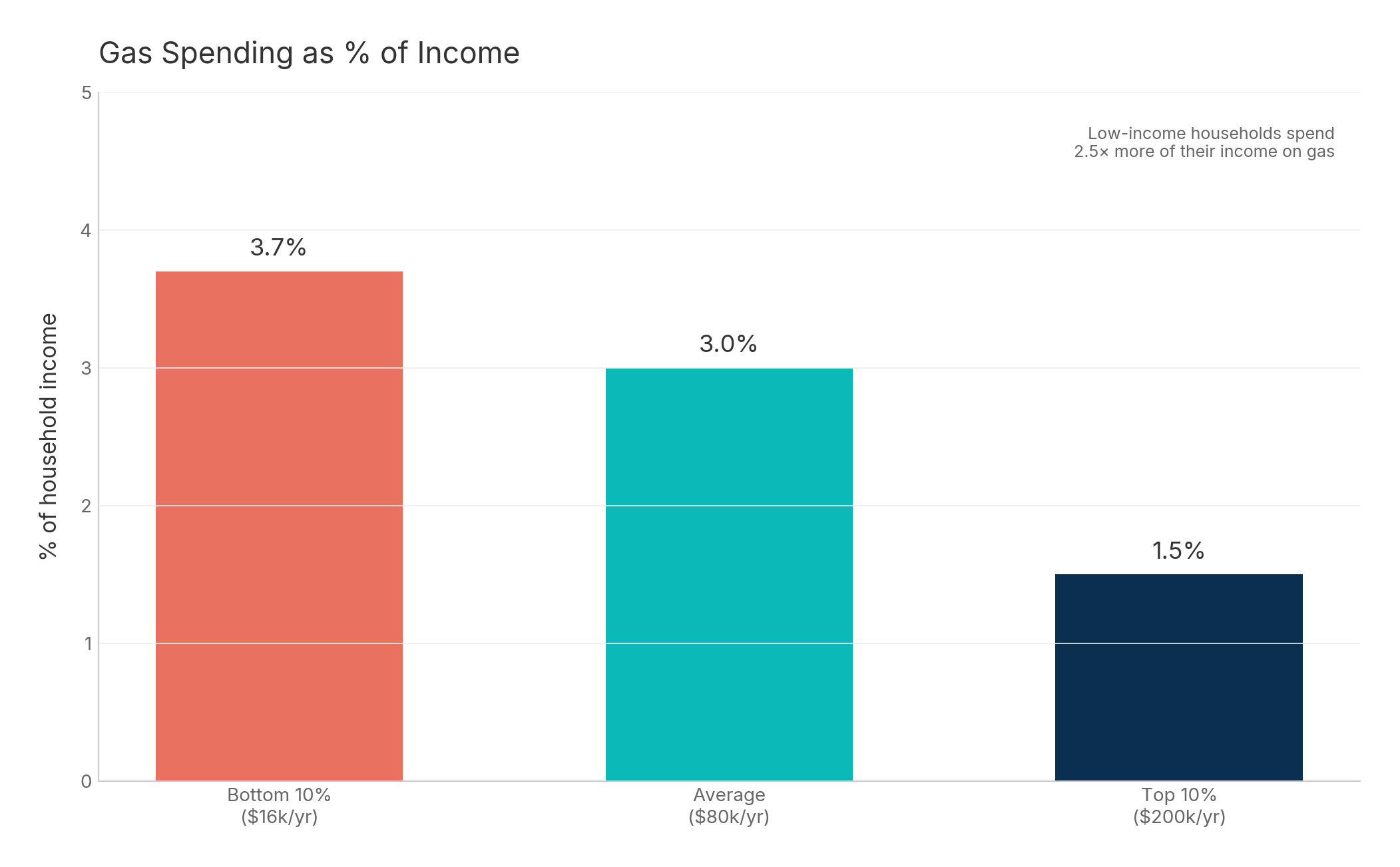
According to Pantheon Macroeconomics (via PBS), the bottom 10% of income earners already spend 3.7% of their income on gas, compared to just 1.5% for the top 10%. After this price spike, that gap becomes a chasm.
| Income Group | Avg Income | Gas % Before | Gas % After | Burden Increase |
|---|---|---|---|---|
| Bottom 10% | ~$16,000/yr | 3.7% | 6.7% | +82% heavier |
| Average | ~$80,000/yr | 3.0% | 3.6% | +20% heavier |
| Top 10% | ~$200,000/yr | 1.5% | 1.7% | +16% heavier |
For someone earning $16,000 a year, the same $487 increase eats nearly 3 additional percentage points of their total income. For someone earning $200,000, it's barely noticeable — a 0.2 percentage point change.
This is the definition of a regressive tax: everyone pays the same amount, but it takes a dramatically larger bite from those who can least afford it. The critical difference? Unlike an actual tax, there's no refund, no credit, and no progressive bracket to soften the blow.
A Reuters/Ipsos poll from March 20–23 (n=1,545) found that 55% of Americans already report a direct financial impact from gas prices, and 87% expect prices to keep rising.
When Will Gas Prices Drop?
Don't expect a quick snapback. Even if the geopolitical situation stabilizes tomorrow, gas prices take weeks to months to come back down.
According to GasBuddy analyst Patrick De Haan, gas prices typically decline at a rate of 1–3 cents per day after a price shock. To recover the full $1.03 increase:
| Decline Rate | Days to Recover | Target Date |
|---|---|---|
| 1¢/day (slow) | 103 days | ~July 2026 |
| 2¢/day (moderate) | 51 days | ~May 2026 |
| 3¢/day (fast) | 34 days | ~May 2026 |
Even in the best-case scenario, prices don't normalize until May. The worst case stretches into July. That's an entire spring and early summer of elevated gas costs.
The government has already attempted intervention — 172 million barrels were released from the Strategic Petroleum Reserve on March 11, according to Reuters. Prices continued climbing anyway.
Planning for elevated costs matters more than hoping for a quick fix.
4 Ways to Cut Your Gas Spending Now
You can't control crude oil prices. But you can control how much gas you buy and what you pay for it. Here are four strategies with real savings numbers attached.
1. Price-Shop With GasBuddy
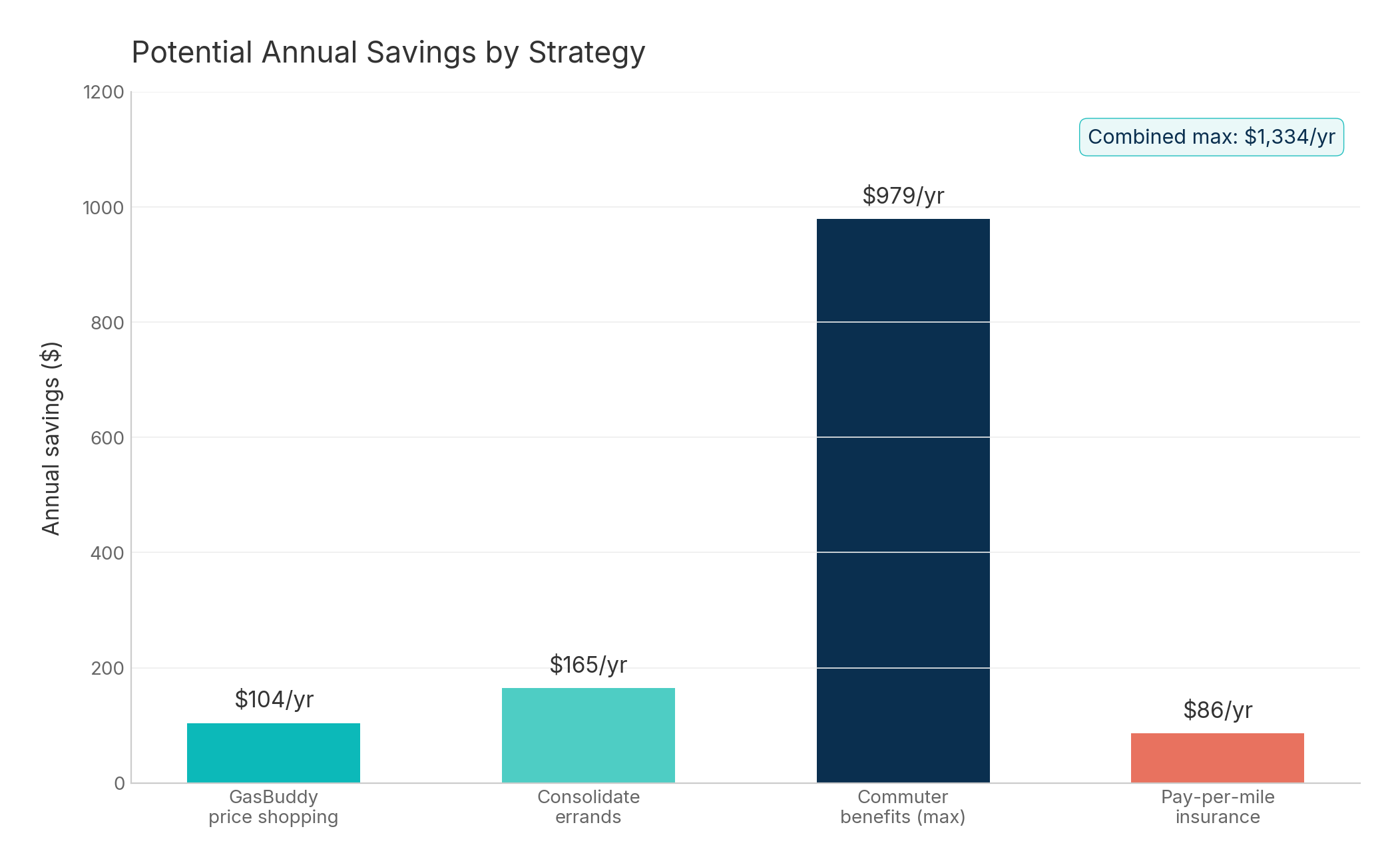
Gas stations within a few miles of each other often charge 20–40 cents per gallon differently. Using GasBuddy to find the cheapest option and saving just 20 cents per gallon on 10 gallons per week adds up to $104 per year.
GasBuddy app usage has increased 30% since the price surge began, according to the company.
2. Consolidate Your Errands
Cutting two unnecessary 5-mile round trips per week saves about 0.8 gallons at current prices. That's $165 per year — just from being more deliberate about when you drive.
Plan your errands in a single loop instead of multiple separate trips. It sounds simple because it is.
3. Enroll in Commuter Benefits
The IRS allows up to $340/month in pre-tax commuter benefits for 2026. If your employer offers this program and you're in the 24% tax bracket, you save up to $82/month in taxes — or $979 per year.
Note: this requires employer participation and typically applies to transit and qualified parking. Check with your HR department.
4. Switch to Pay-Per-Mile Insurance
If you drive under 7,500 miles per year, pay-per-mile insurance could save you an average of $86 per year compared to traditional policies.
Companies like Metromile (now Lemonade) and Mile Auto offer these plans. If you're already driving less, you shouldn't be paying for a full-mileage policy.
The Combined Impact
| Strategy | Annual Savings |
|---|---|
| GasBuddy price shopping | $104 |
| Consolidate errands | $165 |
| Commuter benefits (if eligible) | $979 |
| Pay-per-mile insurance | $86 |
| Combined maximum | $1,334 |
Even without commuter benefits (which require employer participation), the other three universally accessible strategies save $355/year — enough to nearly cover the entire $487 annual cost increase.
Frequently Asked Questions
How much does the 30% gas price increase cost per week?
The average American household (12,000 miles/year, 25.4 MPG) now pays about $9.36 more per week on gas. That works out to $40.55 per month or $487 per year, based on the $1.03/gallon increase tracked by AAA between February and March 2026.
Why do gas price increases affect low-income families more?
Gas prices function as a regressive tax. According to Pantheon Macroeconomics, the bottom 10% of earners spend 3.7% of their income on gas, compared to just 1.5% for the top 10%. The same $487/year increase pushes low-income gas spending from 3.7% to 6.7% of income — an 82% heavier burden.
How long will gas prices stay high in 2026?
According to GasBuddy analyst Patrick De Haan, gas prices typically decline 1–3 cents per day after a price shock. At that rate, recovering the full $1.03 increase would take 34 to 103 days — meaning prices may not normalize until May at the earliest, and possibly not until July.
What are the best ways to save money on gas right now?
Four proven strategies: use GasBuddy to price-shop between stations (saves $104/year), consolidate errands to cut unnecessary trips ($165/year), enroll in employer commuter benefits if available (up to $979/year in tax savings), and switch to pay-per-mile insurance if you drive under 7,500 miles/year (~$86/year).
Does the gas price increase affect other prices too?
Yes. Every $10/barrel increase in oil reduces U.S. consumer spending by 0.2–0.3%. With oil up roughly $27/barrel, the effects ripple into food, shipping, and everything that moves on a truck. Gas is the most visible cost, but it's the tip of a broader inflation wave — the OECD raised its 2026 U.S. inflation forecast to 4.2% from 2.8%.
What to Do Next
The $1.03/gallon gas price increase isn't going away overnight. At current decline rates, elevated prices will persist through spring and likely into summer 2026.
The math is straightforward: the average household is paying $487 more per year, and that burden falls hardest on those earning the least. But unlike most economic pressures, this one has concrete, actionable offsets.
Start with the free options — download GasBuddy and consolidate your errands this week. Then check whether your employer offers commuter benefits. Small changes in how you buy gas can meaningfully cushion the hit to your budget.